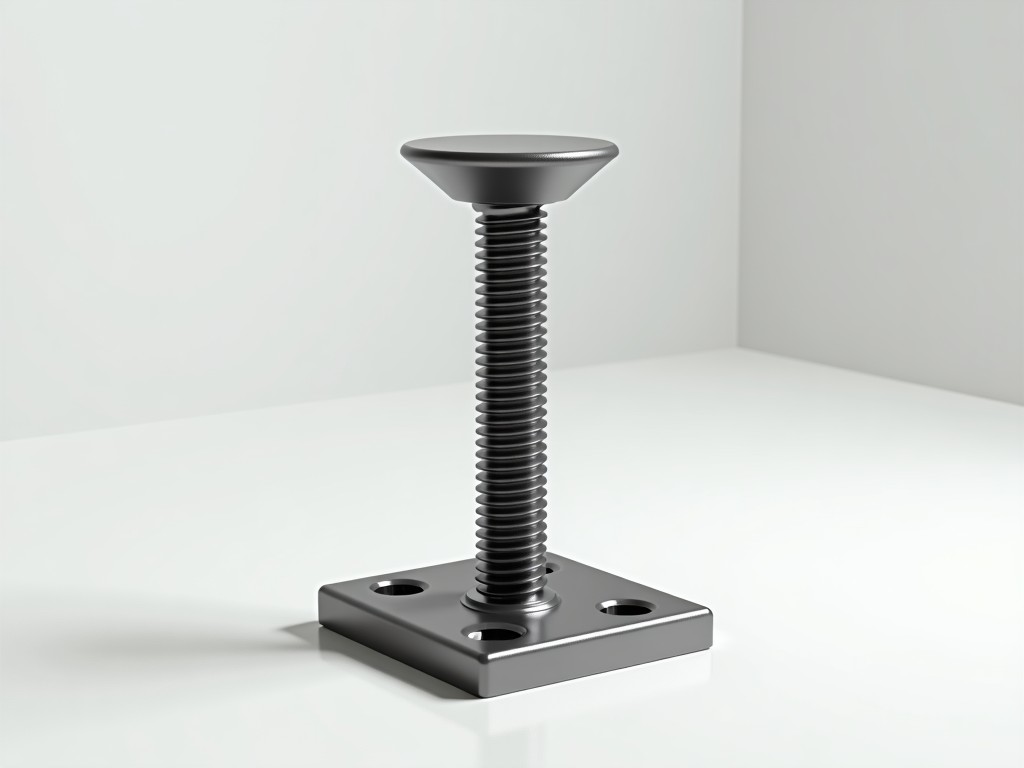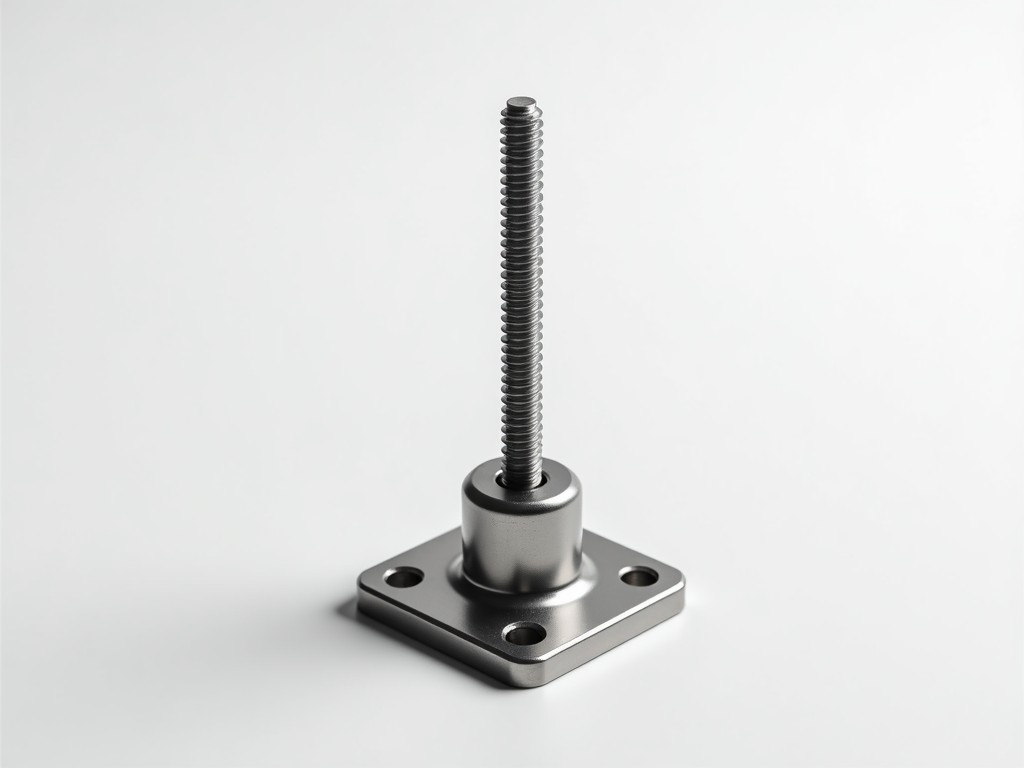
An OEM swivel base screw jack is a mechanical lifting device designed for precise vertical movement in industrial applications where alignment flexibility is required. The swivel base allows the jack to accommodate angular misalignment between the mounting surfaces while maintaining load path integrity. This feature is critical in applications such as conveyor systems, packaging machinery, and assembly lines where foundation tolerances or dynamic loads may introduce angular offsets.
The core mechanism consists of a trapezoidal or ball screw, a worm gear reducer, and a rotating lifting nut. When the input shaft is turned—manually via handwheel or via motorized drive—the worm gear rotates the lifting nut, which translates along the screw to raise or lower the load. The swivel base, typically mounted on a spherical or tapered bearing interface, permits up to 5 degrees of angular deviation from vertical without inducing side loads on the screw or nut assembly.
Load capacity is determined by screw diameter, lead, material strength, and support bearing design. Common capacities range from 2.5 kN to 500 kN depending on model series. Higher capacity units often incorporate dual-start screws or reinforced worm gears to manage increased torque requirements. Self-locking capability is inherent in trapezoidal screw designs due to high friction angles, preventing back-drive under static load—an important safety consideration in positioning applications.
| Parameter | Typical Range or Specification |
|---|---|
| Load Capacity (Static) | 2.5 kN – 500 kN |
| Screw Diameter | 18 mm – 100 mm |
| Screw Lead (Trapezoidal) | 4 mm – 24 mm |
| Gear Ratio (Worm) | 6:1 – 32:1 |
| Swivel Angle | ±5° from vertical |
| Input Torque @ Full Load | Dependent on lead and gear ratio; typically 5–200 Nm |
| Lifting Speed (Manual) | 10–50 mm per handwheel revolution |
| Operating Temperature | -20°C to +80°C (standard seals); extended range available |
Material selection influences durability, corrosion resistance, and suitability for specific environments. Housing components are commonly made from ductile iron (GGG40) or cast steel for high stiffness and damping. Worm gears are typically forged from case-hardened alloy steel (e.g., 20CrMnTi) to withstand contact stresses. Screws may be supplied in C45 carbon steel for general use or stainless steel (304/316) for food processing, pharmaceutical, or outdoor environments. Lubrication is facilitated via grease nipples on worm housings and screw protectors, with maintenance intervals dependent on duty cycle and ambient conditions.
The swivel base interface requires careful design to prevent binding or uneven load distribution. It typically consists of a hardened steel seat mating with a spherical washer or tapered ring, allowing controlled angular movement while transmitting axial load. Some designs incorporate a floating flange or gimbal mount to further reduce edge loading. Proper installation requires the base to sit flat on the mounting surface with full contact; shimming may be necessary to compensate for surface irregularities. The swivel function does not compensate for parallel offset—alignment in the horizontal plane must still be addressed during installation.
In packaging machinery, swivel base screw jacks are used to adjust sealing bar height or conveyor elevation. The ability to tolerate minor foundation settling or frame distortion ensures consistent product sealing without requiring frequent realignment. In automotive assembly lines, they support ergonomic workstation positioning where floor slope or turret rotation introduces angular variance. The swivel base maintains vertical load transfer even as the workstation tilts, preventing binding in the screw mechanism.
Material handling systems utilize these jacks for lift table height adjustment in loading docks or workstation ergonomics. Dynamic loads from moving pallets or operators can induce transient angular moments; the swivel base absorbs these without transferring harmful side loads to the screw nut. In metal forming equipment, such as press brakes or stamping dies, they provide precise die height compensation where bed parallelism may degrade over time due to thermal expansion or wear.
Compared to fixed-base jacks, the swivel variant reduces installation sensitivity and minimizes the need for precision shimming or machining of mounting surfaces. This lowers initial assembly time and long-term maintenance costs in environments subject to vibration, thermal cycling, or settlement. However, the swivel interface adds slight radial play and increases overall height compared to rigid mounts—factors to consider in envelope-constrained designs.
OEM swivel base screw jacks are frequently adapted to specific machine integration requirements. Input options include handwheels, motor flanges (IEC or NEMA), or shaft extensions for tandem drive systems. Output configurations range from standard top plates to threaded rods, clevis ends, or custom adapters matching customer-guided load interfaces. Screw protection is available via bellows, spiral guards, or telescopic covers depending on exposure to chips, coolant, or washdown environments.
Gear ratios can be selected to balance lifting speed and manual effort. Higher ratios reduce input torque but increase turns per millimeter of lift—suitable for infrequent adjustment. Lower ratios enable faster manual operation but require greater force. Motor-driven systems often use frequency inverters for soft start and position feedback via encoders or limit switches. For synchronized multi-jack systems, mechanical synchronization shafts or electronic control with PLC feedback prevent tilting or binding.
Lubrication strategy is tailored to duty cycle and accessibility. Sealed-for-life worm housings reduce maintenance in inaccessible locations, while external grease points allow re-lubrication in high-cycle applications. Screw lubrication may be manual or automated via centralized systems. In cleanroom or hygienic zones, smooth surfaces, crevice-free designs, and food-grade lubricants are specified to meet sanitation standards.
Environmental adaptations include corrosion-resistant coatings (e.g., zinc-nickel, epoxy), stainless steel fasteners, and specialized seals for high humidity or chemical exposure. In hazardous areas, ATEX or IECEx certified versions are available upon request, featuring non-sparking materials and sealed enclosures. Custom paint colors or branding can be applied for OEM integration visibility.
Manufacturing begins with material traceability for critical components—screws, worm gears, and housings are accompanied by mill certificates. Gear tooth profiles are inspected using profilometers or coordinate measuring machines (CMM) to verify lead deviation and pitch accuracy within ISO 1328 standards. Screw straightness is checked before and after heat treatment to ensure minimal runout, which directly affects torque uniformity and wear life.
Swivel interface surfaces are ground to specified roughness (typically Ra 0.8–1.6 μm) and hardness (HRC 58–62 for wearing parts) to ensure consistent seating and prevent fretting. Assembly includes pre-load adjustment of worm bearings to eliminate backlash while maintaining smooth torque transmission. Final verification includes load testing at 125% of rated capacity to confirm structural integrity and self-locking performance under static conditions.
Documentation provided with each unit includes installation drawings, lubrication schedules, and torque specifications for mounting bolts. For customized units, acceptance test reports may include input torque vs. lift measurements, backlash measurement, and swivel angle validation. Traceability is maintained via serial numbers linking to production records, inspection logs, and material certificates.
For procurement engineers evaluating long-term value, consider the total cost of ownership: initial price, installation effort, maintenance frequency, and expected service life under duty cycle. A well-selected swivel base screw jack reduces alignment-related downtime and extends screw life by minimizing side loading. Consult with the manufacturer’s application engineering team during specification to confirm load dynamics, mounting conditions, and environmental factors—this collaborative approach minimizes risk and ensures the solution performs as intended over its operational lifespan.