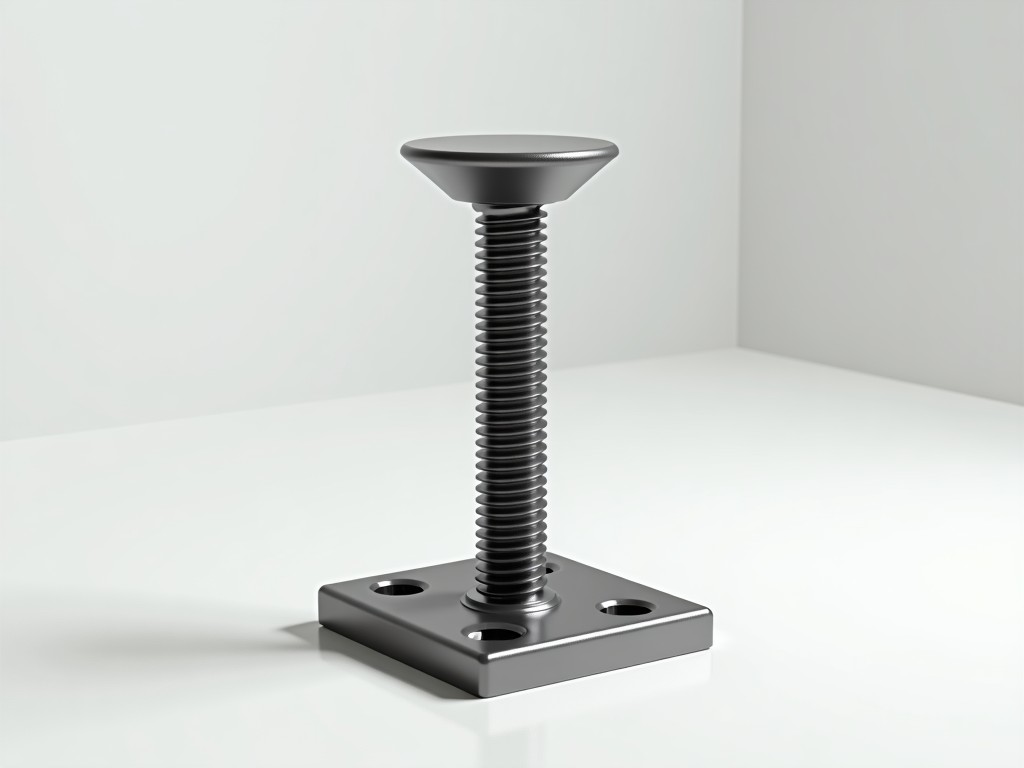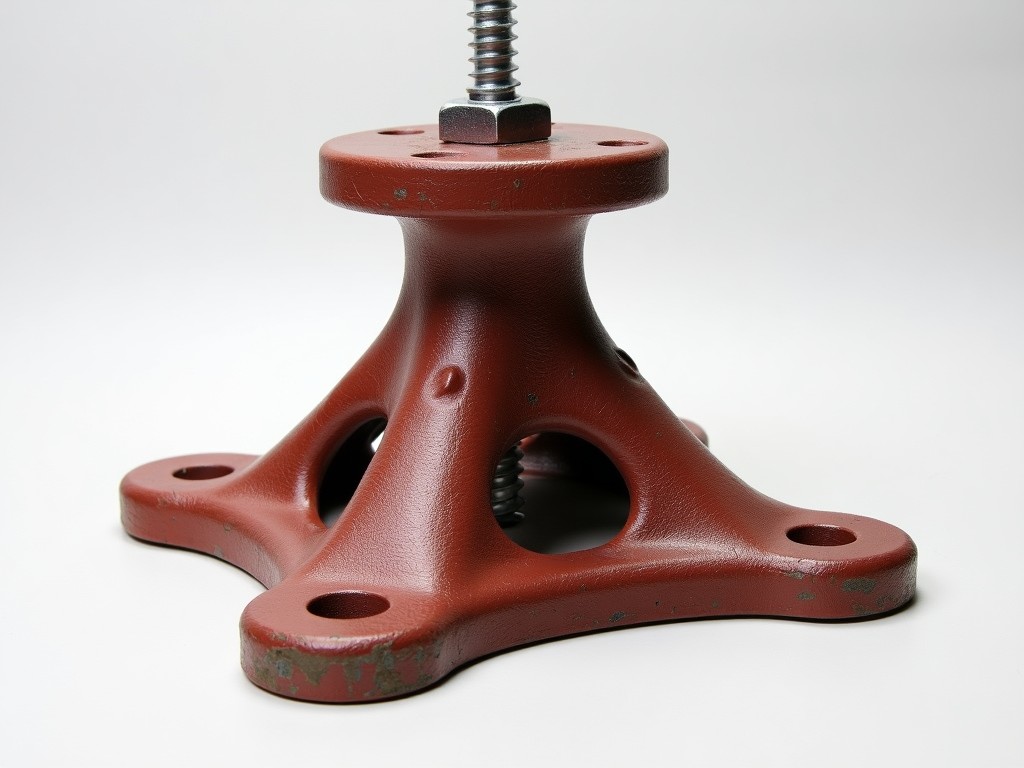
Screw jacks are mechanical actuators that convert rotary motion into linear thrust or tension through a threaded shaft and worm gear mechanism. Cast iron construction is selected for its inherent damping properties, dimensional stability under load, and resistance to deformation in static or low-cycle industrial applications. This material choice directly influences the jack’s ability to maintain positional accuracy over extended periods without creep or elastic recovery issues commonly seen in lighter alloys.
The housing and base of these jacks are typically made from gray cast iron (ASTM A48 Class 30 or equivalent), chosen for its excellent machinability, wear resistance, and ability to absorb vibrational energy. Unlike steel or aluminum alternatives, cast iron does not require additional surface treatments to achieve adequate corrosion resistance in indoor industrial environments, reducing long-term maintenance needs. Its high carbon content also provides natural lubricity at bearing surfaces, minimizing galling between moving parts under high compressive loads.
Load ratings for cast iron construction screw jacks are determined by the tensile strength of the worm gear, the shear area of the lifting screw, and the buckling resistance of the housing under eccentric loading. Standard models range from 5 kN to 200 kN static load capacity, with dynamic ratings typically 60–70% of static values due to impact and vibration factors. The mechanical advantage is governed by the gear ratio and screw pitch; common configurations achieve 20:1 to 40:1 ratios, enabling manual operation via handwheel or motorized drive with modest input torque.
Critical design considerations include the slenderness ratio of the lifting screw to prevent Euler buckling under compressive loads, especially in tall or extended configurations. Housing wall thickness is calculated to resist radial deflection caused by off-center loading, ensuring the nut remains aligned with the screw thread to avoid binding or premature wear. These calculations follow ISO 6336 and ANSI B17.1 standards for worm gearing and power screw design, ensuring predictable performance under repeated cycles.
These jacks are commonly used in industrial settings where precise, slow-speed positioning is required under constant or intermittent load. Unlike hydraulic systems, they do not require fluid maintenance or pose leakage risks, making them suitable for clean environments such as food processing or pharmaceutical equipment adjustment. Their mechanical simplicity also ensures operation during power outages when manual override is needed.
In manufacturing, they support die height adjustment in stamping presses, mold clamping in injection molding machines, and conveyor elevation in packaging lines. The inherent damping of cast iron reduces vibration transmission from nearby motors or presses, improving positional stability in precision assembly tasks. In construction and maintenance, they serve as reliable leveling supports for heavy machinery, turbine bases, or temporary shoring during equipment installation.
Standard configurations can be adapted to specific installation requirements through modifications to lifting screw length, end fittings, gear ratio, and input drive type. For high-cycle applications, bronze nuts can be specified to reduce wear compared to iron-on-iron contact. Motorization options include IEC-frame AC motors, DC gearmotors, or manual handwheels with position indicators, allowing integration into automated systems or manual override scenarios.
Environmental adaptations include stainless steel worm shafts for washdown areas, sealed bellows boots to protect screw threads from dust or splatter, and special greases for high-temperature or food-grade compatibility. Mounting interfaces can be customized to match existing flange patterns or base plates, reducing installation time and alignment effort. All modifications are evaluated for impact on load capacity, buckling resistance, and self-locking capability.
Production begins with pattern making and sand casting to achieve near-net-shape housings, followed by stress relief annealing to minimize residual stresses that could cause distortion during machining. Critical surfaces such as worm gear mounts, bearing bores, and base mounting planes are machined to IT6–IT8 tolerances to ensure proper alignment and load distribution. Worm gears are typically made from hardened steel (e.g., 20CrMnTi) and ground to achieve surface finish below 0.8 μm Ra for efficient power transfer and long service life.
Each unit undergoes functional testing under load to verify input torque versus output thrust, backlash measurement, and self-locking performance. Dimensional inspection includes screw straightness, thread lead accuracy, and housing squareness. Traceability is maintained via batch numbers linked to material certifications, heat treatment records, and test logs. While not typically certified to ISO 9001 for standard industrial components, manufacturers follow documented process controls consistent with quality management principles.
| Property | Cast Iron | Carbon Steel | Aluminum Alloy |
|---|---|---|---|
| Density (g/cm³) | 7.2 | 7.8 | 2.7 |
| Damping Capacity | High | Low | Very Low |
| Machinability | Excellent | Good | Fair |
| Typical Use Case | Static/low-cycle industrial positioning | High-cycle, high-load applications | Mobile or weight-sensitive equipment |
| Corrosion Resistance (indoor) | Good (uncoated) | Requires coating | Good (oxide layer) |
The table above illustrates why cast iron remains preferred for many industrial screw jack applications despite its higher weight compared to steel or aluminum. Its superior damping reduces resonance-induced positioning errors in environments with nearby motors or presses. Machinability allows for cost-effective production of complex housing features such as integrated mounting flanges and worm gear bearing pockets. While steel offers higher tensile strength, it requires additional processing to achieve comparable wear resistance and damping, increasing cost without proportional benefit in low-speed, high-static-load scenarios.